
Giant Skeleton: Emma Rose Schwartz
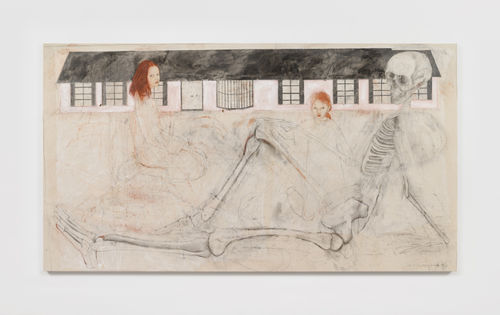
Kraupa-Tuskany Zeidler is pleased to announce Giant Skeleton, Emma Rose Schwartz’s first exhibition with the gallery.
EMMA ROSE SCHWARTZ
Giant Skeleton
Kraupa-Tuskany Zeidler, Berlin (DE)
28.02.2026–10.04.2026
Opening: Friday, 27.02.2026, 5–8 pm
Giant Skeleton takes its name from what has become a minor monument in American folk culture: a 12 foot tall skeleton sold by Home Depot, popularly named “Skelly.” Produced as a seasonal decoration yet too large to be conveniently stored, it has, in many places, become a semi-permanent fixture in yards, lingering long after the holiday it was meant to signify. The exhibition unfolds in the atmosphere of late autumn, at the end of the growing season, when light recedes and the year’s decorations remain in place like after-images.
EMMA ROSE SCHWARTZ (b. 1992, Toronto, Canada) lives and works in New York. She received a BFA from the School of the Art Institute of Chicago (2014) and an MFA from Columbia University (2019). Through a process of layering, erasing, and carving into un-stretched canvas, Schwartz builds paintings that hold both image and sediment, where the surface becomes a record of touch and revision. Her compositions often unfold in folkloric or suburban settings, drawn from memory, myth, and the architecture of her Nashville upbringing, where figures appear as recurring archetypes of the self. Her work examines how identity, inheritance, and fiction coalesce in the act of depiction.
Relevant exhibitions include Andrew Kreps Gallery, New York (2026, forthcoming); Kraupa-Tuskany Zeidler, Berlin (2026, solo); Derosia, New York (2025, solo); Brunette Coleman, London (2024, solo); In Lieu, Los Angeles (2023, solo); Annarumma Gallery, Naples (2022, solo); Chapter, New York (2021, solo); Margot Samel, New York (2024); Hesse Flatow, New York (2024); Paulina Caspari, Munich (2024); Thierry Goldberg, New York (2023); Christian Andersen, Copenhagen (2022); and In Lieu, Los Angeles (2022). She received the Helen Frankenthaler Foundation Venice Award (2019) and was artist in residence at Xenia Creative Retreat (2025).
-
 Giant Skeleton, exhibition view, Kraupa-Tuskany Zeidler, Berlin, 2026
 -
Giant Skeleton, exhibition view, Kraupa-Tuskany Zeidler, Berlin, 2026
-
Giant Skeleton, exhibition view, Kraupa-Tuskany Zeidler, Berlin, 2026
-
Giant Skeleton, exhibition view, Kraupa-Tuskany Zeidler, Berlin, 2026
-
Giant Skeleton, exhibition view, Kraupa-Tuskany Zeidler, Berlin, 2026
-
Giant Skeleton, exhibition view, Kraupa-Tuskany Zeidler, Berlin, 2026
-
Giant Skeleton, exhibition view, Kraupa-Tuskany Zeidler, Berlin, 2026




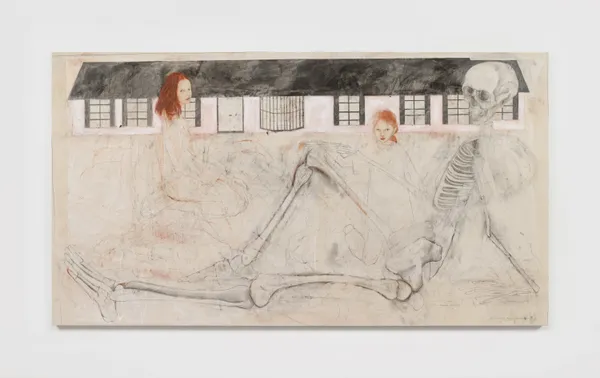



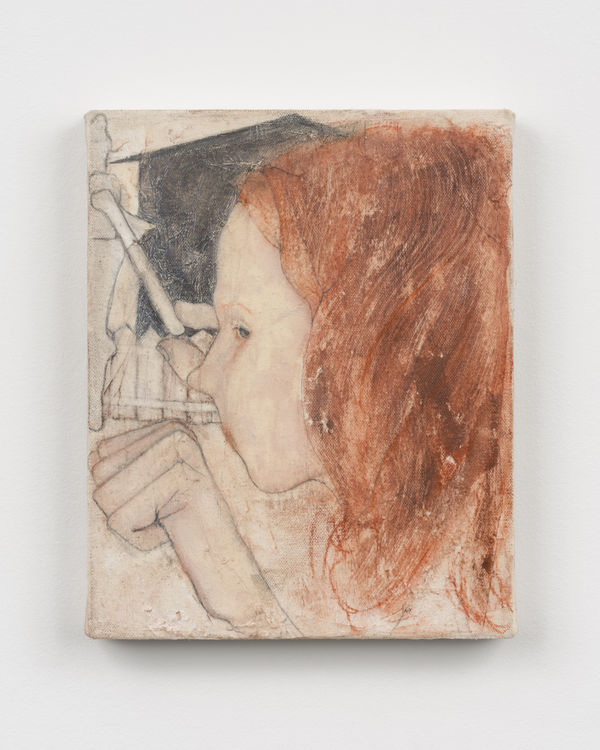

Giant Skeleton takes its name from what has become a minor monument in American folk culture: a 12 foot tall skeleton sold by Home Depot, popularly named 'Skelly.' Produced as a seasonal decoration yet too large to be conveniently stored, it has, in many places, become a semi-permanent fixture in yards, lingering long after the holiday it was meant to signify.
The exhibition unfolds in the atmosphere of late autumn, at the end of the growing season, when light recedes and the year’s decorations remain in place like after-images. Mortality is not introduced as a spectacle so much as a background condition. In the eponymous painting, Giant Skeleton (2026), two girls play beside a reclining skeleton in front of a ranch-style house. The skeleton appears as more of a companion than a threat, even as a kind of attendant presence. Halloween and its related traditions share the notion of a thinning veil between the living and the dead, a moment when mortality becomes newly visible. This visibility is softened through humor, costume, and ceremony. What we fear is dressed up, anthropomorphized, and condescended towards.
This idea of the 'thin veil' operates not only seasonally but materially within Schwartz’s paintings, engaging the memory of a surface. Paper is peeled back from the canvas with a knife, punctured and abraded, leaving the record of removal intact. Oil, conté, graphite, chalk pastel, and charcoal accumulate in thin layers, drawn from tones close to the artist's own complexion and earlier drafts remain visible as stains, scars, or ghosts. The image appears less as a window and more as a site of pressure, where what has been covered insists upwards.
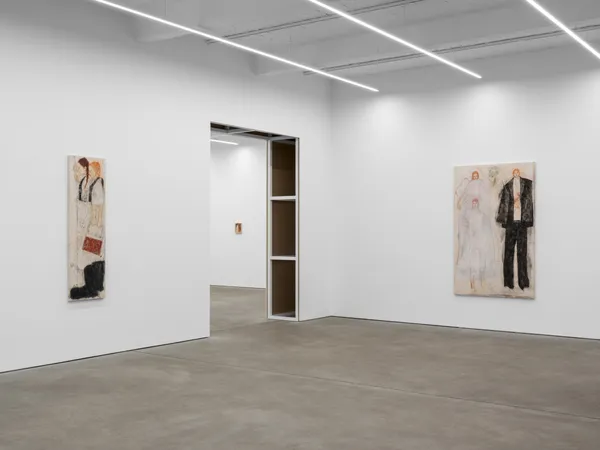
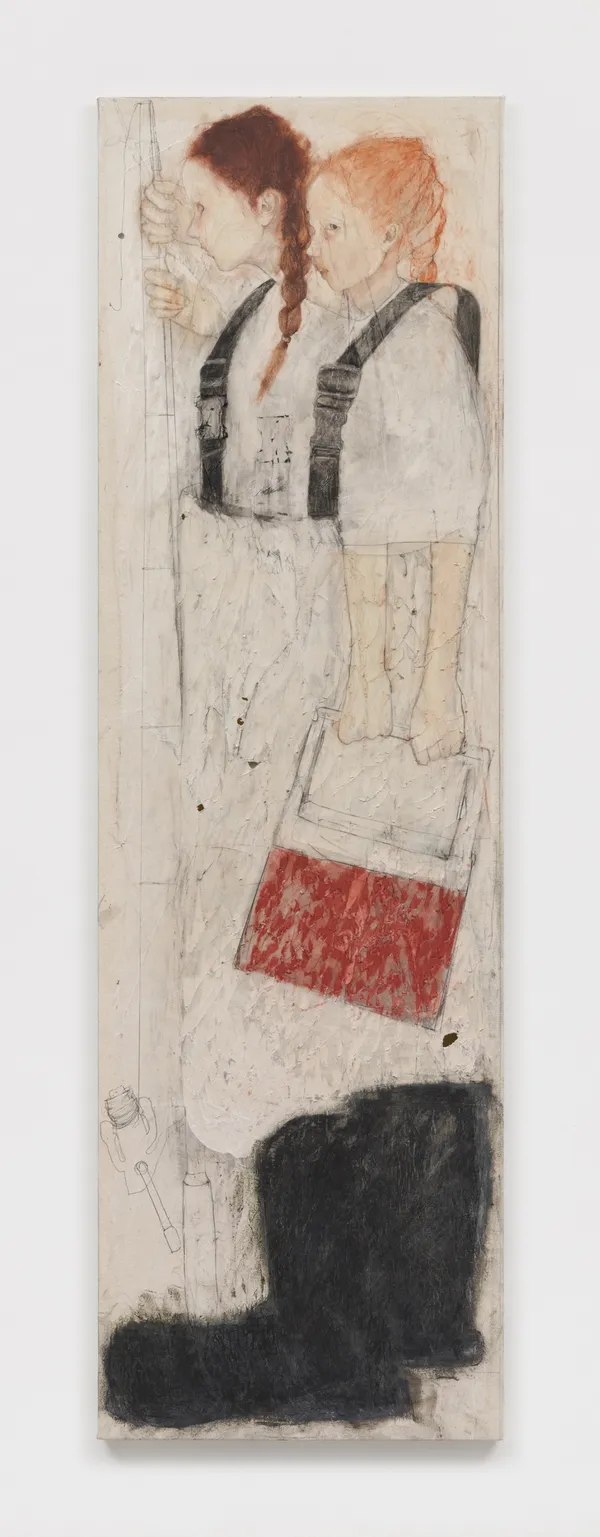
Figures recur in stacks and conglomerations in Schwartz’s Style of Dress and Two Legged (both 2026). Girls stand on each other's shoulders, forming composites that confuse scale and distance. Two bodies become one; three approximate the height of a skeleton. The flattening of space collapses near and far, making the foreground and horizon feel equally compressed. These accumulations suggest lineage and repetition; individuals as fragments within a larger structure; the self becomes less of a fixed identity than a costume worn across multiple images.
Adults are largely absent in Schwartz’s works, instead she depicts childhood and its rehearsal of adulthood. Dress and uniform reappear as questions: what distinguishes costume from gear, disguise from protection? In Two Legged, figures wear fishermen’s waders, garments that function as practical equipment and, for the children inside, as shelter, architecture, and a playhouse. Clothing serves as a safety protocol, class indicator, and the early sign of belonging: the way a body is assigned to a team, a school, and later to a function. Yet Schwartz locates dress at an earlier, more elastic stage, before uniform hardens into identity through metonymy. In Style of Dress, children are shrouded in clothing which is exaggerated in scale as well as type– these being the most quintessential 'adult' clothes one could imagine.
Where Schwartz’s children gather in shifting conglomerations of peers, the pairing of stag and fawn in Country Gentlemen (2026) is defined by proximity of a different kind: filial. Deer are often treated in folklore as threshold figures, moving between worlds. In the American landscape, they are seen doing exactly that, crossing between rural fields and suburban neighborhoods, appearing at the edges of built environments. Their presence is inseparable from late autumn: in the end of the growing season and the onset of the hunting season, when mortality is not abstract but practiced as ritual. The painting departs from the world of dress-up and rehearsal that shapes much of the exhibition, yet it does not abandon its grammar. Perspective remains collapsed, space pressed forward, figures stacked into a single, shallow field. The agrarian setting, previously felt as backdrop, becomes more palpable here. The work visualizes lineage in a body of paintings preoccupied with role, costume, and repetition. The temporary, so central elsewhere in the exhibition, appears here as something carried forward. Schwartz’s new works locate childhood within architectures and rituals that rehearse the inevitability of endings.
